Evidence Lab
Separate observation, account, inference and assumption before deciding what the material actually supports. What do we know, and who says so?

 ORVIA Oversight
 Business in a Box
 ORVIA Voice
 ORVIA Web
 Safeguarded by ORVIA
 ORVIA Assurance
 ORVIA Overwatch
 ORVIA Security
 ORVIA Witness Room
 ORVIA Threshold
 ORVIA Academy
 ORVIA Foundation
People improve judgement by using it: confronting uncertainty, hearing another perspective, testing an assumption, changing a view and explaining why. ORVIA Insight turns those moments into something people can practise.
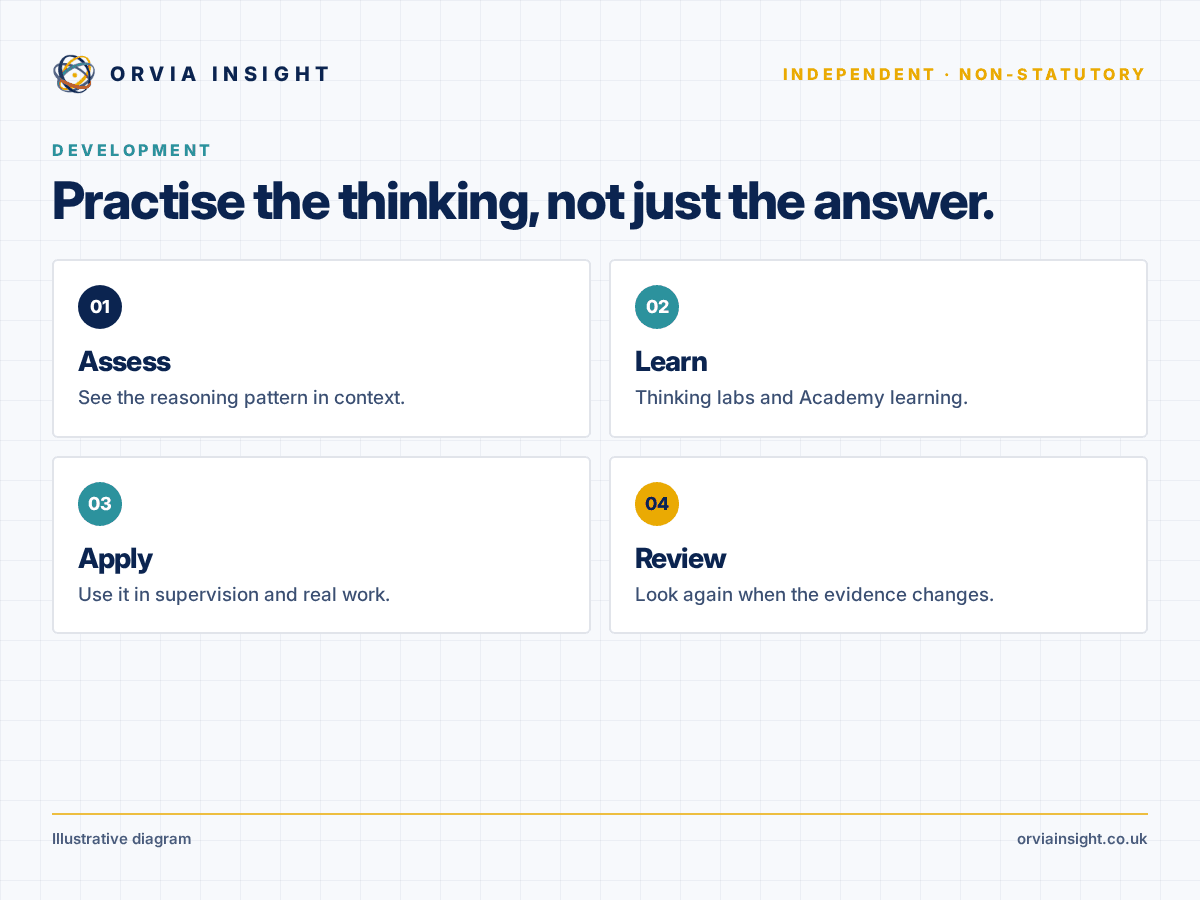
Insight can reveal a reasoning pattern in context: perhaps someone jumped from allegation to fact, avoided challenge, became overconfident with incomplete evidence or struggled to explain a decision. Development then turns that observation into something the person can practise.
These can be used in facilitated sessions, supervision, leadership programmes, Academy learning or structured team discussion, always adapted to the role and context.
Separate observation, account, inference and assumption before deciding what the material actually supports. What do we know, and who says so?
Re-run the same situation from another human viewpoint without changing the underlying evidence. What can they see that I cannot?
Build more than one plausible explanation and identify what evidence would distinguish them. What else could explain this?
Question weak certainty, including your own, without turning professional challenge into combat. What would change my mind?
Act proportionately while some facts remain unavailable, disputed or still emerging. What needs action now?
Turn a complex professional judgement into an explanation another person can understand and test.
A situation unfolds. The group commits to a view. New evidence arrives. Someone disagrees. Time pressure appears. Then the facilitator slows the room down and asks what changed.
What do you think is happening?
What did you assume?
What else could explain it?
What will you do differently next time?
The wider ORVIA model can connect the evidence from Insight to targeted learning and support in practice, while keeping the consequential decision with humans.
Observe the reasoning pattern in a controlled situation.
Build the underlying capability with relevant learning.
Support the person while the real work is happening (planned).
ORVIA development should make it safer to admit uncertainty, ask better questions and change a view when the evidence changes. That is not weakness. It is how organisations stop confidence becoming a substitute for evidence.
TRUST SHOULD BE INSPECTABLE
Company registration, external recognition and ORVIA’s own programme are shown separately, so you can see what each one means. Every item links to its source.